
Why Mini Excavator Size Matters More Than You Think
Walk into any equipment dealership or scroll through any rental catalog and you'll quickly discover that "mini excavator" covers an enormous range — from sub-1-ton micro machines to 6-ton compact workhorses. That spectrum exists for a reason: a machine spec'd for demolishing a basement wall is overkill for a backyard pond, and a 1-ton machine will spend two frustrating days doing what a 2.5-ton unit finishes before lunch.
The sweet spot between underpowered and oversized isn't a matter of taste — it's a matter of digging depth, swing radius, transport weight, and fuel burn. Getting it right the first time means lower operating costs, better site access, and a machine you'll actually want to own for years.
Quick Takeaway
Most residential and light commercial buyers fall into the 1T–2.5T range. Municipal utilities, commercial site prep, and mid-scale landscaping typically warrant a 3T–4T machine. Anything above 6T generally moves out of the "mini" category altogether.
5 Key Factors That Should Drive Your Decision
1. Job Site Access & Transport
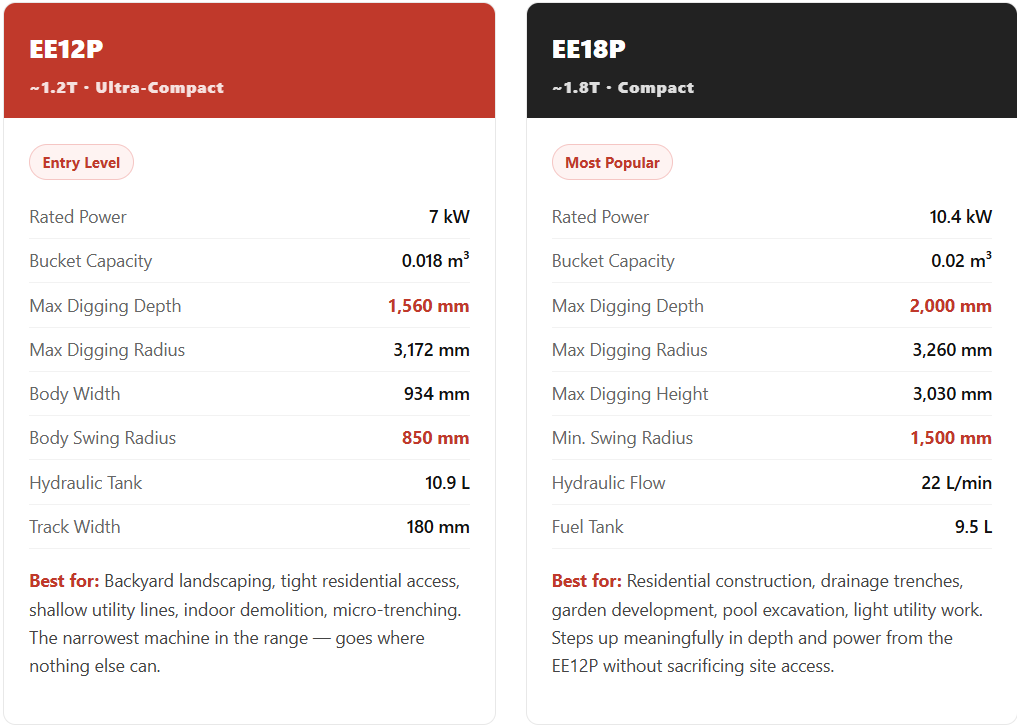
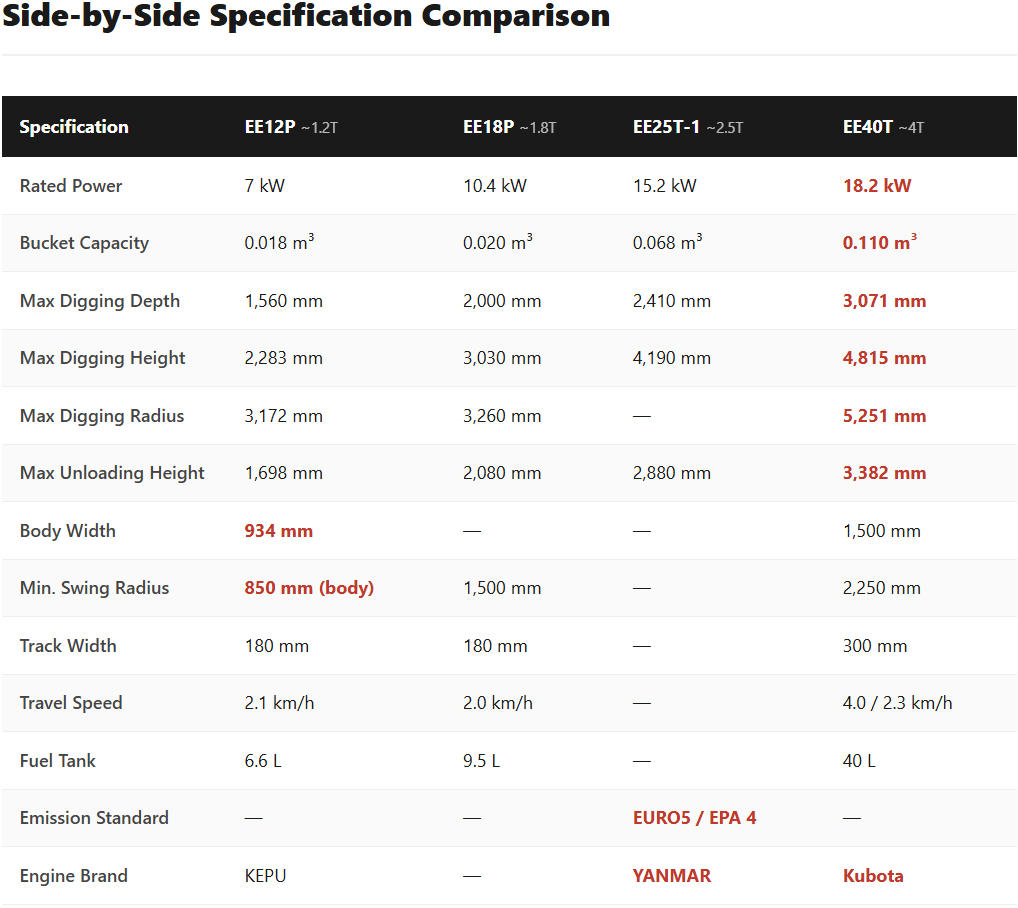
Can you get a larger machine in? Backyard gates, narrow urban alleys, and low-clearance basements all impose hard limits on body width and swing radius. The EURTROL EE12P, for instance, measures just 934 mm wide — narrow enough to fit through a standard 36-inch residential gate with room to maneuver. Step up to the EE40T and you're looking at a 1,500 mm body width that demands proper site planning.
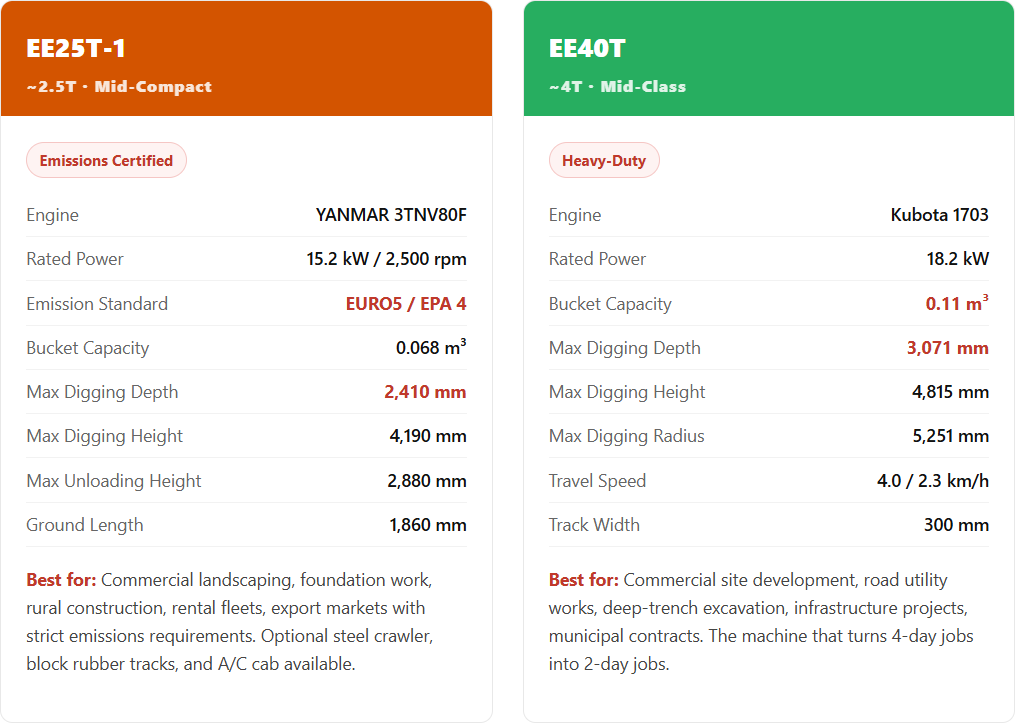
Transport is equally important. Machines under 2.5 tons typically fit on a standard single-axle trailer without special permitting. The EE25T-1 ships in a wooden box measuring 3,950 × 1,420 × 1,850 mm — manageable with a pickup and a small flatbed. The EE40T requires more logistical thought.
2. Required Digging Depth
Every job has a depth requirement. Shallow utility trenches (under 1.5 m), planting beds, and drain lines are well-served by a 1T–1.8T machine. Foundation footings, septic systems, and water mains typically need 2.0–3.0 m of depth — the territory where the EE18P (2,000 mm max depth) and EE25T-1 (2,410 mm) shine. The EE40T pushes to an impressive 3,071 mm for demanding commercial applications.
3. Lifting & Loading Capacity
Digging force and bucket capacity scale with machine weight. The EE12P's 0.018 m³ bucket moves a few hundred kilograms per cycle — fine for landscaping topsoil. The EE40T's 0.11 m³ bucket (more than six times larger) is a different tool entirely, suited for moving rock, gravel, or clay at meaningful production rates.
4. Swing Radius & Zero-Tail Swing
Working near fences, foundations, or parked vehicles demands a tight swing radius. The EE12P's 850 mm body swing radius means the tail barely clears a curb. The EE18P offers a minimum swing radius of 1,500 mm with a chassis extension range of 160 mm for extra stability on uneven ground. Always check the spec sheet — "zero-tail swing" marketing can mean different things across brands.
5. Engine Power & Emission Compliance
Power isn't just about speed — it determines how efficiently the machine handles hard ground. The EE12P runs a modest 7 kW engine, appropriate for its size. The EE25T-1 features a YANMAR 3TNV80F at 15.2 kW, EURO5/EPA 4 compliant — a meaningful differentiator for rental fleets and government contracts that enforce emissions standards. The EE40T pairs a Kubota 1703 engine with 18.2 kW for serious pulling power.
EURTROL Mini Excavator Lineup: Know Your Options
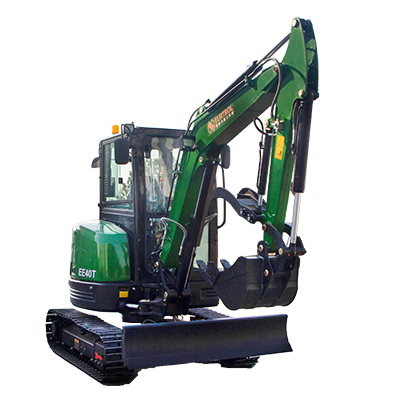
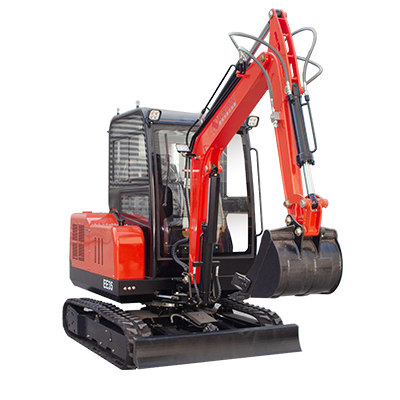
EURTROL's current compact range spans four clearly differentiated models. Rather than overlapping niches, each machine targets a specific weight class and application tier — from the ultra-compact EE12P to the serious mid-class EE40T.
Which Tonnage Is Right for You? A Practical Decision Guide
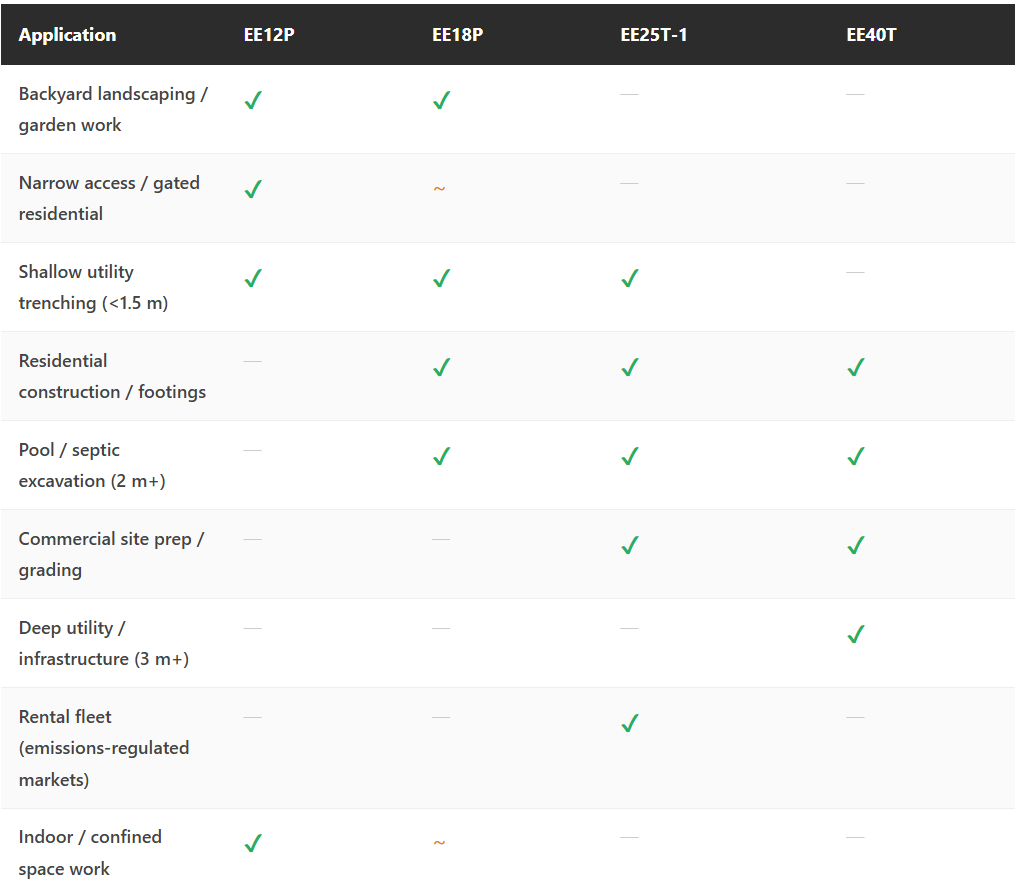
Forget specs for a moment. Think about your job. The table below maps real-world applications to the machine that handles them most efficiently across four dimensions: reach, depth, access, and productivity.
Attachments & Versatility: One Machine, Many Tools
All four EURTROL models feature an attachment linkage system with hydraulic quick-coupler capability, turning each machine into a platform rather than a single-purpose tool. The attachment ecosystem is where compact excavators genuinely earn their keep.
Standard Attachments Across the Range
Enlarged Bucket — Higher-capacity earthmoving for loose soils and topsoil stripping
Front Shovel — Load-and-carry capability for material handling without a separate skid steer
Attachment Linkage / Quick Coupler — Fast tool changes without leaving the cab
Hydraulic Pipe Outlets — Powers hammers, augers, tilting buckets, grapples, and more
Model-Specific Highlights
EE12P & EE18P — Hydraulic pilot control and dual travel motors (KEEN / LIWO) for precise grading and positioning. The EE18P adds foot pedal control and a cabin fan for all-day operator comfort, along with a fire extinguisher mount for compliance-sensitive job sites.
EE25T-1 — The Thumb Grip attachment option and LED lighting package expand productivity into material handling and low-light operations. Optional A/C cab makes this a serious year-round machine in hot climates.
EE40T — Full undercarriage with 300 mm tracks, dual-speed travel (4.0 / 2.3 km/h), and a 35° climbing angle handle demanding terrain. Li Kechuan swing and travel motors provide responsive, reliable hydraulic performance under heavy load.
Frequently Asked Questions
What is the most popular mini excavator size for homeowners?
The 1T–1.8T class — specifically models like the EURTROL EE12P and EE18P — dominates homeowner and small contractor purchases. These machines fit through standard gates, load on a light trailer, and handle everything from drainage work to tree stump removal without damaging lawns or hardscaping.
Is a 1-ton mini excavator powerful enough for real digging?
Absolutely — within its intended application. The EE12P delivers 7 kW of hydraulic power and digs to 1,560 mm depth, which covers the majority of residential utility and landscaping work. Where it reaches its limits is in hard clay, rocky ground, and repeated deep-trench digging. For those conditions, step up to the EE18P or EE25T-1.
Do I need EURO5/EPA 4 emission compliance?
If you're operating in the European Union, California, or any jurisdiction with Tier 4 Final regulations — yes, it's mandatory. The EURTROL EE25T-1 is the only model in this lineup currently certified to EURO5/EPA 4, making it the clear choice for rental fleets, government contracts, and export to regulated markets. Always verify current local regulations with your dealer.
Can I transport a 2.5T mini excavator with a pickup truck?
Yes, with the right trailer. The EE25T-1's shipping box is 3,950 × 1,420 × 1,850 mm, and the operating weight falls within the towing capacity of most 3/4-ton and 1-ton pickup trucks (when paired with a suitable tandem-axle trailer). Check your truck's rated towing capacity and tongue weight limits — and always verify local road regulations for trailer weight without special permits.
What's the difference between rubber tracks and steel tracks?
Rubber tracks (standard on EE12P and EE18P) are gentler on finished surfaces — pavers, asphalt, lawns — and quieter in operation. Steel tracks (an optional configuration on the EE25T-1) offer superior durability on rocky or abrasive terrain and are typically preferred for demolition sites or rough rural work. The EE25T-1 also offers block rubber tracks as a compromise option that combines reasonable surface protection with improved traction.
How do I decide between the EE18P and EE25T-1?
The EE18P is the better value for light residential and landscaping work where you need a nimble, easy-to-transport machine. Choose the EE25T-1 when your jobs regularly demand depths beyond 2 m, when emissions compliance is required, or when you need the YANMAR engine's proven reliability and global parts availability. The EE25T-1's larger bucket (0.068 m³ vs. 0.02 m³) is also a strong productivity argument on larger soil-moving jobs.