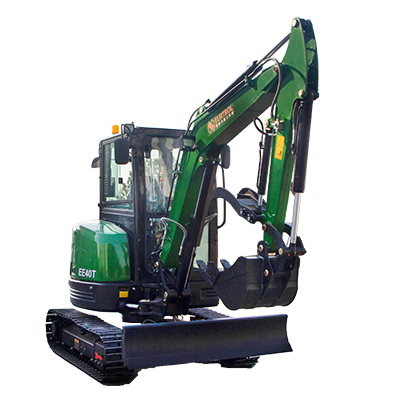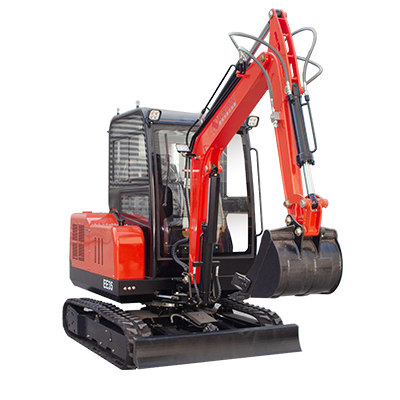

The front of an excavator is the side with the boom, arm, and bucket — the working end. The cab faces forward, and the counterweight sits at the rear. On a standard machine, the sprocket drive wheels are at the back of the undercarriage, which is another reliable reference point.
4 Ways to Tell Front from Back
1. The Cab and Controls
The operator's cab is always oriented toward the front. When you're seated in the cab, you're looking forward — toward the work tool. If you can see the boom directly ahead through the front windshield, you're looking at the front of the machine.
2. The Boom, Arm, and Bucket
The working attachment — boom, arm, and bucket — is mounted at the front of the upper structure. No attachment = back of the machine.
3. The Counterweight
A large cast-iron counterweight bolts to the rear of the upper structure. It's heavy, curved, and deliberately positioned at the back to offset the weight of the front-mounted work tool. If you see the counterweight, you're looking at the rear.
4. The Track Drive Sprockets
On the undercarriage, the drive sprockets (toothed drive wheels connected to the hydraulic motors) are located at the **rear** of the tracks. The front of the undercarriage has the idler wheels, which are smooth and unpowered. This distinction holds even when the upper structure has rotated.
Why Does It Matter?
Jobsite communication — When a spotter says "move forward," everyone needs to agree on which direction that is. On most excavators, "forward" means the cab/boom direction.
Tramming (traveling) — When driving an excavator, the recommended practice is to travel with the boom facing forward where terrain allows. This gives the operator better visibility and keeps the heavier counterweight trailing, which improves stability on inclines.
Safe operation on slopes — On a grade, always position the machine so the heavy counterweight faces uphill. This means traveling up a slope in reverse (counterweight leading), which is a standard safety rule.
FAQ
Does the front change when the upper structure rotates?
No — the front of the upper structure is always the boom side. But the undercarriage has its own fixed front (idler end). When the cab has rotated 180°, the boom points over the rear of the tracks — this is a common working position but does not change the machine's structural front/back.
Which way should I park an excavator?
Lower the bucket to the ground, park on level terrain where possible, and position the tracks so the drive sprockets are at the rear. This is the standard rest position.
Interested in compact excavators for your project? Browse our mini excavator lineup or contact our team for specs and pricing.*